Barometer
A Journey to the Centre of the EarthThe manometer is the expedition’s pressure-measuring instrument and, after the storm destroys most of the party’s equipment, the one scientific device Professor Hardwigg considers essential. It gives practical form to the book’s recurring tension between measurement and theory: pressure can be read, recorded, and used to guide the descent, but its significance still depends on the Professor’s interpretations and on the instrument remaining available.
Preparation and purpose
Before the expedition leaves, its equipment is divided into four groups: instruments, arms, tools, and provisions. The manometer belongs to the scientific apparatus. It is worked by compressed air and is intended to ascertain atmospheric pressure; Professor Hardwigg reasons that it may be more suitable than an ordinary barometer because pressure is likely to increase as the party descends below the Earth’s surface. Its purpose is therefore practical as well as observational: it is meant to make the changing conditions of the underground route measurable.
That function distinguishes it from an instrument carried merely to verify a prior expectation. The manometer is part of a planned system of observation, and its readings are connected to the expedition’s location and bodily exposure. It enters the journey as equipment packed in advance, but the conditions underground make it increasingly consequential: the air is denser, and the travelers need to understand how descent affects the pressure around them.
Readings, records, and interpretation
Professor Hardwigg records the manometer’s indications every hour, alongside those of the compass and thermometer. The resulting measurements contribute to his detailed account of the voyage and help him specify the party’s position. The instrument thus participates in a chain of knowledge: it registers a physical condition, the Professor keeps a regular record, and those observations support his account of where the travelers are. Measurement is not an incidental detail of the expedition but part of how the route becomes describable and its progress is assessed.
The manometer also enters a conversation about how the explorers may withstand the atmosphere below ground. Professor Hardwigg asks Harry to consult it; Harry reports considerable pressure. The Professor takes this reading as evidence that descending slowly and gradually becoming accustomed to the denser atmosphere will prevent serious harm. Harry remains wary, anticipating discomfort in his ears. The exchange gives the device a role in a judgment about safety, while preserving the difference between a pressure reading and the conclusion drawn from it: the instrument reports a condition, and the Professor turns that report into reassurance.
In a further discussion, the Professor acknowledges that atmospheric density will continue to increase, while invoking a poorly defined law under which the intensity of weight diminishes with depth and bodies would have no weight at the Earth’s centre. He also recognizes that air could eventually attain the density of water under pressure of seven hundred and ten atmospheres. These claims place the manometer within a broader attempt to reason about subterranean conditions. The readings matter because the environment is changing, but the conversation also shows that measurement does not eliminate uncertainty about the laws governing the journey.
Survival after the storm
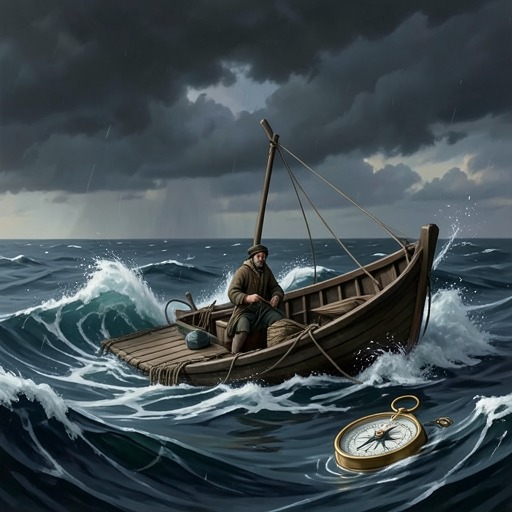
After the storm, the expedition suffers severe losses: its weapons vanish, while the powder survives. The manometer remains, and Professor Hardwigg welcomes it as a substitute for the rest of the lost instruments. In his view, it alone will allow him to calculate their depth as they proceed and decide when they have reached the centre of the Earth; without it, he jokes grimly, they might mistake their position and emerge at the antipodes. His laughter makes the claim sound both triumphant and strained, as though retaining one instrument can restore a measure of order after the storm’s destructive reversal.
The change is sharp. Before the storm, the manometer formed one part of a larger collection, used together with the compass and thermometer and entered into systematic hourly observations. Afterwards, it is elevated from one instrument among many to the expedition’s indispensable remaining measure. The party has lost much of its capacity for scientific observation, yet the Professor holds onto the belief that this single device can still orient their progress in depth. Its importance comes not only from what it measures, but from the continued possibility of calculation amid material loss.
Limits and significance
The manometer’s importance does not make it infallible or self-explanatory. Its reading of considerable pressure supports the Professor’s account of gradual adaptation, but that account remains an interpretation rather than a guarantee. Likewise, the instrument can help him calculate depth, yet its survival cannot restore the vanished compass or the full set of instruments. The expedition’s knowledge is therefore materially dependent: observation requires tools, records require repeated readings, and conclusions remain vulnerable to incomplete evidence and changing circumstances.
As an object, the manometer connects the practical demands of travel with the scientific ambition to chart the Earth’s interior. It measures an invisible condition, helps turn descent into a sequence that can be recorded, and acquires greater authority when disaster strips the expedition of alternatives. The episode also reveals the limits of that authority. A surviving instrument can support a calculation, but it cannot by itself settle every question about the world the explorers encounter.